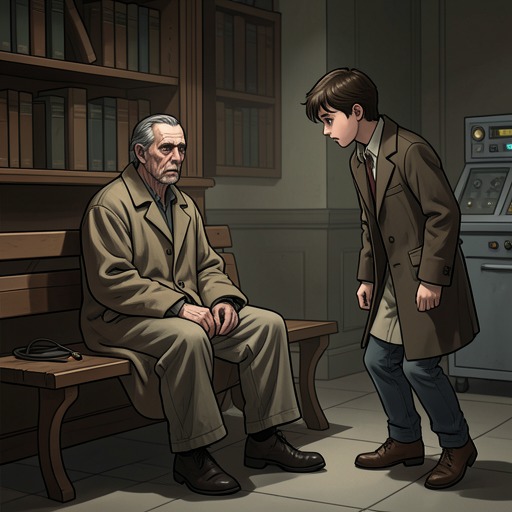
The Rube
Naked LunchThe Rube is a con man whose survival depends on a boyish image that gradually becomes impossible to maintain. The narrator first presents him as Little Boy Blue, a figure whose sentimental appearance conceals the deterioration brought on by junk; as that image gives way, The Rube becomes a danger to himself and a liability to those around him. His abandonment in Philadelphia and disappearance into the East River turn his personal collapse into one of the book’s starkest images of addiction’s cost.
Identity and Background
The Rube’s defining attribute is the contrast between appearance and condition. The narrator describes him as having a sincere, almost storybook look, likening him to a boy who might have stepped from a Saturday Evening Post cover with a string of bullheads. The image is not simply a disguise imposed from outside: The Rube has preserved himself in junk, sustaining the appearance even as the drug’s effects accumulate. The nickname Little Boy Blue captures the fragile, childlike persona on which that appearance depends.
That persona is bound to The Mark Inside, the hidden vulnerability that the narrator says no con man can defeat. The Rube’s confidence and practiced identity cannot protect him from an inward collapse. The text imagines the boyish surface slipping and something intolerable emerging beneath it; the change is not a successful revelation of a truer, stronger self, but the breakdown of the identity that had held him together.
Life and Plot Trajectory
The Rube’s decline is shown through changes in his body and conduct. In Philadelphia, the narrator demonstrates the mechanics of administering a solution, then recalls that The Rube’s thigh felt cold and waxlike and that fluid emerged from the puncture. The encounter makes his condition concrete: the body that addiction has left behind no longer registers as normally alive to the narrator. This detail anticipates the broader description of The Rube’s attacks becoming habitual.
His episodes increasingly govern how other people respond to him. Police, doormen, dogs, and secretaries are said to react with hostility as he approaches, while the narrator calls him a social liability. The decline is therefore both personal and social: The Rube is losing command of himself, and his presence threatens to draw scrutiny onto the people travelling with him. Outside Philadelphia, he jumps out to approach a police car, and the officers’ reaction makes the narrator fear that the whole group will be caught.
Relationships and Conflict
The narrator’s relationship with The Rube is shaped by companionship, shared exposure to danger, and a growing impulse to separate. The narrator knows his condition at close range, handles the practical details of administering drugs, and remains aware that The Rube’s public episodes can implicate everyone with him. Yet when the danger becomes immediate, the narrator chooses concealment and escape rather than continued care.
That choice takes its clearest form on a Philadelphia street corner. The narrator tells The Rube to wait while he goes to contact a doctor, giving the practical explanation that he does not want the doctor to notice him. The promise that he will return is immediately undercut by the narrator’s farewell. The scene makes abandonment a deliberate act, not an accidental separation: The Rube is left standing alone beneath a steady fall of soot, while the narrator leaves him behind.
Change and Ending
The Rube’s final transformation is presented as the collapse of the boyish image he had maintained. In the narrator’s account, he runs through empty automats and subway stations, calling for the lost boy to come back. His pursuit turns inward breakdown into a literal search for the self that has disappeared; the childlike identity that once protected him is now something he can only call after.
The ending carries that loss into the East River. The Rube follows the absent boy into the water, among urban refuse and the remnants of the city, descending toward a dark, silent depth. The account gives no recovery or return, and the narrator’s final question about where people go when they leave the body behind keeps the outcome suspended between death and disappearance. The Rube’s end is thus not a resolved rescue narrative but the culmination of a self that addiction has hollowed out and made unreachable.
Narrative Role and Significance
The Rube’s story concentrates the book’s recurring concern with identity as something that can be sustained, damaged, and lost. Little Boy Blue is at once a social performance and a sign of the person The Rube can no longer recover. The contrast between that gentle image and the narrator’s increasingly severe descriptions of his condition gives the character’s decline its force without turning it into a conventional tale of redemption.
The narrator’s own actions complicate the account. He recognizes The Rube’s vulnerability, describes his physical deterioration, and leaves him anyway. That tension makes the episode more than a portrait of addiction: it also exposes the limits of companionship when another person’s crisis becomes a threat to one’s safety. The final image of The Rube disappearing into the river extends the book’s larger sense of bodies and identities becoming difficult to distinguish from the waste and darkness around them.